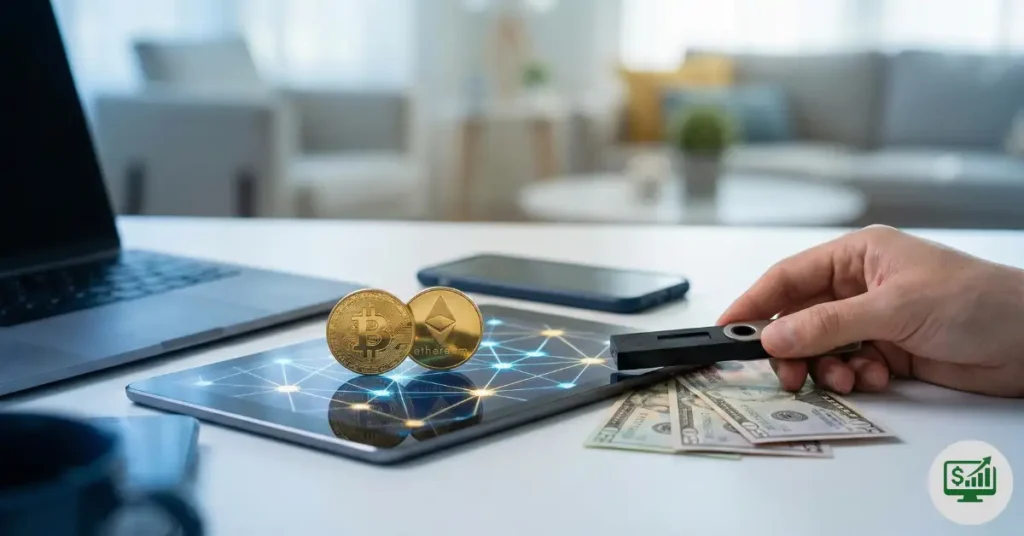
I still remember the night I watched $12,000 vanish in four minutes during the Luna crash.
One moment the chart was steady. The next… freefall.
That was the night I realized most people buy crypto without actually knowing how it works — myself included, back in the early days.
Today, I’m going to explain crypto in the simplest, most no-BS way possible so you don’t repeat my mistakes.
The Promise Line
By the end of this guide, you’ll understand what crypto really is, how blockchain works, why wallets matter, how transactions move, and why security must come first—no hype, no jargon dumps.
1. What Cryptocurrency Actually Is
Here’s the thing about crypto:
It’s not “magic internet money.”
It’s digital money secured by math instead of banks.
- No central authority
- No government switching the system on/off
- No bank holding your funds
Each coin runs on a blockchain — a public record of transactions stored across thousands of computers.
Think of it like a shared Google Sheet that no single person can edit, but everyone can verify.
2. How Blockchain Works (The Brain of Crypto)
When you send crypto, this is what really happens:
- You create a transaction.
- The network broadcasts it to thousands of independent computers (nodes).
- Miners/validators check if you actually own the crypto you’re trying to send.
- Once verified, your transaction is added into a “block.”
- That block is chained to previous blocks, forming — guess what — the blockchain.
Because every block is linked, changing history is almost impossible. That’s why crypto can exist without a central bank.
Why This Matters
It stops fraud.
It prevents double-spending.
It ensures no one can secretly print new coins (looking at you, Federal Reserve).
3. Hot Wallets vs Cold Wallets (Where Crypto Actually Lives)
Here’s another thing beginners get wrong:
You don’t “store” Bitcoin or Ethereum. You store the KEYS to access them.
And those keys can be in two places:
Hot Wallets (Online)
Examples: MetaMask, Trust Wallet, Coinbase Wallet
- Easy to use
- Great for beginners
- But connected to the internet = hackable
Cold Wallets (Offline)
Examples: Ledger, Trezor
- Physically stores your keys offline
- Almost impossible to hack
- Ideal for long-term storage
I’ve seen too many traders lose everything because their hot wallet was compromised.
If you plan to hold for months or years, use a cold wallet.
I learned this lesson the expensive way.
4. How Crypto Transactions Move
A crypto transaction includes three parts:
- Your wallet address (like your bank account number — public)
- Your private key (like your ATM pin — NEVER share)
- Gas fee (network fee to process your transaction)
About Gas Fees
People complain that Ethereum gas fees are high. True.
But they exist for a reason:
Fees prevent spam and reward the network for validating transactions.
Compare gas fees across networks:
- Ethereum: High, but secure
- Bitcoin: Medium
- Solana: Very low
- Polygon: Extremely low
Always check fees before sending funds.
5. Exchanges: Coinbase vs Binance vs Kraken
I’ve used all of them during bull runs, crashes, hacks, and sleepless trading nights.
Coinbase
- Easiest for beginners
- Regulated in the US
- Higher fees
- Fantastic UI
Binance
- Low trading fees
- Huge coin selection
- Best for active traders
- Regulatory issues in the US (Binance US is limited)
Kraken
- Extremely secure
- Transparent
- Not as “pretty” as Coinbase
- Excellent customer support
Rule:
Use exchanges for buying/selling, not long-term storage.
6. The Real Risks (Crypto Is NOT All Sunshine)
Crypto is volatile. Brutally volatile.
I’ve woken up to +40% green days and –60% bloodbaths.
Major risks:
- Extreme price swings
- Hacks
- Phishing scams
- Rogue founders draining liquidity
- Exchange collapses (FTX — I still get chills)
Crypto is powerful tech, but it doesn’t care about your feelings or savings.
7. Common Crypto Scams & Red Flags
I’ve seen these patterns repeat every bull run:
🚩 “Guaranteed returns”
🚩 Anonymous team, no GitHub, no whitepaper
🚩 Telegram admins blocking questions
🚩 Token supply locked in developer wallets
🚩 New coins promising 100x “next month”
🚩 Fake airdrop links stealing wallet keys
🚩 Phishing emails mimicking Coinbase/MetaMask
If it sounds too good to be true…
In crypto, it’s usually a rug pull.
8. Real Trade Breakdown (My Painful Lesson)
During the 2021 bull market, I bought an altcoin after a friend said:
“Bro, this coin is the next Ethereum.”
Red flag №1.
I ignored fundamentals.
I ignored tokenomics.
I ignored the fact that the liquidity pool looked suspiciously small.
Within 48 hours, the project rugged.
Lost $3,500.
That loss taught me more than any YouTube tutorial ever could.
9. Beginner’s Crypto Checklist
Before you even buy $1 of crypto:
✔ Understand how wallets work
✔ Write down your seed phrase ON PAPER
✔ Turn on 2FA on exchanges
✔ Start with Bitcoin or Ethereum before touching altcoins
✔ Never click random airdrop links
✔ Triple-check wallet addresses before sending
✔ Start small, learn the system, then scale
Logan’s Signature Warning
Crypto rewards the patient and destroys the reckless.
Only invest what you’re emotionally ready to lose.
Not a dollar more.