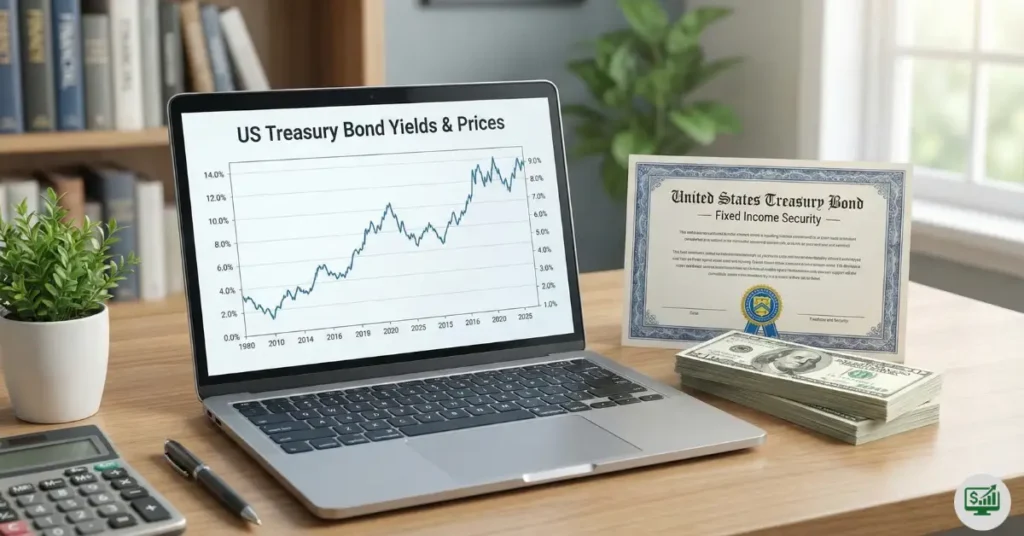
When the Federal Reserve began raising interest rates aggressively in 2022, I watched something many beginners didn’t expect: long-term bond prices fell sharply, even though bonds are often called “safe investments.”
That moment confused millions of new investors — and it’s exactly why understanding how bonds actually work matters.
By the end of this guide, you’ll understand bonds from the ground up — how they generate income, why prices move, when they reduce risk, and when they quietly become dangerous.
I’ll explain this the same way I do for policy teams and first-time investors alike: clearly, calmly, and with real U.S. market examples.
Bond Basics (Plain English)
At its core, a bond is a loan you give to an institution.
- You lend money
- The borrower promises to pay you interest
- You get your original money back at maturity
That’s it.
When you buy a U.S. Treasury bond, you are lending money to the U.S. government.
When you buy a corporate bond, you are lending money to a company like Apple or Microsoft.
Unlike stocks, bonds do not represent ownership. They represent a legal obligation to repay.
Key Bond Terms Every Beginner Must Know
Let’s define the four terms that matter most:
| Term | What It Means |
|---|---|
| Face Value (Par) | The amount you get back at maturity (usually $1,000) |
| Coupon Rate | The fixed interest rate paid on the bond |
| Maturity | When your principal is returned |
| Yield | The return you earn based on price paid |
If you understand these four concepts, bonds stop being confusing.
Types of U.S. Bonds (Explained Simply)
1. U.S. Treasury Bonds (Safest)
- Issued by the U.S. government
- Backed by federal taxing power
- Extremely low default risk
Common Treasury types:
- T-Bills: under 1 year
- T-Notes: 2–10 years
- T-Bonds: 20–30 years
These are the global benchmark for “risk-free” assets.
2. Municipal Bonds (Tax Advantage)
- Issued by states and cities
- Often tax-free income
- Slightly higher risk than Treasuries
Popular with retirees in higher tax brackets.
3. Corporate Bonds (Higher Income, Higher Risk)
- Issued by companies
- Higher yields than government bonds
- Credit quality matters a lot
A bond from Apple ≠ a bond from a struggling startup.
How Bond Prices and Yields Really Work
This is the most important concept — and where beginners get lost.
Bond prices and yields move in opposite directions.
Let’s examine the rate impact.
- You own a bond paying 3%
- New bonds start paying 5%
- Your bond becomes less attractive
- Its price falls
This relationship explains every major bond market move.
Real Example: 2022 Bond Sell-Off
When the Fed raised rates rapidly:
- 10-year Treasury yields jumped above 4%
- Long-term bond funds fell 15–25%
- Many investors were shocked
Bonds didn’t “fail” — duration risk surfaced.
Why Interest Rate Changes Matter So Much
Interest rates are the gravity of the bond market.
When rates:
- Rise → bond prices fall
- Fall → bond prices rise
The longer the maturity, the stronger the effect.
Duration Risk (The Silent Risk)
Duration measures how sensitive a bond is to rate changes.
Rule of thumb:
A 1% rate increase causes a bond to lose roughly its duration % in value.
| Duration | 1% Rate Increase Impact |
|---|---|
| 2 years | ~2% loss |
| 7 years | ~7% loss |
| 20 years | ~20% loss |
This is why long-term bonds can be volatile.
When Bonds Become Risky
Bonds are not risk-free. They carry different types of risk:
1. Interest Rate Risk
Prices fall when rates rise.
2. Credit Risk
The borrower may fail to repay (corporate & junk bonds).
3. Inflation Risk
Fixed payments lose purchasing power.
4. Liquidity Risk
Some bonds are hard to sell quickly.
Understanding which risk you’re taking matters more than chasing yield.
Bond Funds vs Individual Bonds
This distinction is critical.
Individual Bonds
- Known maturity date
- Known principal return (if no default)
- Predictable cash flow
Bond Funds
- No maturity date
- Prices fluctuate continuously
- Suitable for diversification, not guarantees
Many beginners think bond funds behave like bonds. They don’t.
When Bonds Outperform Stocks (Historically)
Bonds shine during:
- Recessions
- Market crashes
- Deflationary shocks
- Flight-to-safety periods
Example: 2008 Financial Crisis
- Stocks fell over 35%
- Long-term Treasuries gained double digits
This negative correlation is why bonds stabilize portfolios.
The Yield Curve Explained (Beginner Friendly)
The yield curve plots interest rates across maturities.
- Normal curve → economy expanding
- Flat curve → uncertainty
- Inverted curve → recession warning
Historically, every U.S. recession was preceded by an inverted yield curve — not immediately, but reliably.
How Retirees Use Bonds for Stability
Bonds are income tools, not growth engines.
Retirees use them to:
- Generate predictable income
- Reduce portfolio volatility
- Fund near-term expenses
A common strategy is a bond ladder:
- Bonds maturing at different years
- Steady cash flow
- Lower reinvestment risk
Corporate vs Government Bonds (Quick Comparison)
| Feature | Government Bonds | Corporate Bonds |
|---|---|---|
| Safety | Very High | Varies |
| Yield | Lower | Higher |
| Default Risk | Minimal | Depends on issuer |
| Best For | Stability | Income seekers |
Beginner Mistakes to Avoid
- Assuming bonds can’t lose value
- Ignoring duration risk
- Chasing high-yield junk bonds
- Treating bond funds like savings accounts
- Forgetting inflation impact
Most bond losses come from misunderstanding risk, not bad luck.
Simple Checklist Before Buying a Bond
- What is the maturity?
- What is the duration?
- Who is the issuer?
- How does inflation affect returns?
- Do I need liquidity?
If you can answer these, you’re ahead of most investors.
Final Thoughts
Bonds aren’t exciting — and that’s exactly the point.
They exist to:
- Preserve capital
- Smooth volatility
- Provide predictable income
When used correctly, bonds are the quiet stabilizers of serious portfolios.
Bonds won’t make you rich fast — but they can keep you from getting poor fast.