I still remember standing in the H-E-B checkout line in Houston, staring at my receipt and thinking, “Where did my money even go?”
Bills were paid. Groceries were bought. Gas tank was half full.
And yet… my bank balance was back to almost zero — again.
If you’re living paycheck to paycheck right now, trust me — you’re not bad with money. You’re just stuck in a system that doesn’t leave much breathing room. I’ve been there. Single income. Tight budget. Kids’ needs always coming first.
But here’s the honest truth: saving your first $1,000 is possible — even on a tight income — if you stop trying to save “big” and start saving right.
Let me show you exactly how I did it, step by step.
Why $1,000 Matters (More Than Any Other Number)
Before we talk tactics, let’s get real.
That first $1,000:
- Stops small emergencies from becoming credit card debt
- Gives you mental peace (this part is underrated)
- Breaks the paycheck-to-paycheck cycle
This isn’t about becoming rich.
This is about not panicking every time your car makes a weird noise.
Step 1: Stop Saying “I Can’t Save” — Change the Rule
The biggest mistake I made early on was thinking:
“I’ll save once I make more money.”
That day never comes.
Instead, I changed one rule:
Savings comes first — even if it’s tiny.
I started with $25 per paycheck.
Sometimes $10. Sometimes $40.
What mattered was consistency, not amount.
👉 If you’re paid biweekly, $25 = $650 a year.
👉 Weekly? Even $15 adds up fast.
Step 2: Create a “Mini Emergency Fund” (Not a Perfect Budget)
Forget fancy spreadsheets for now.
Your only goal:
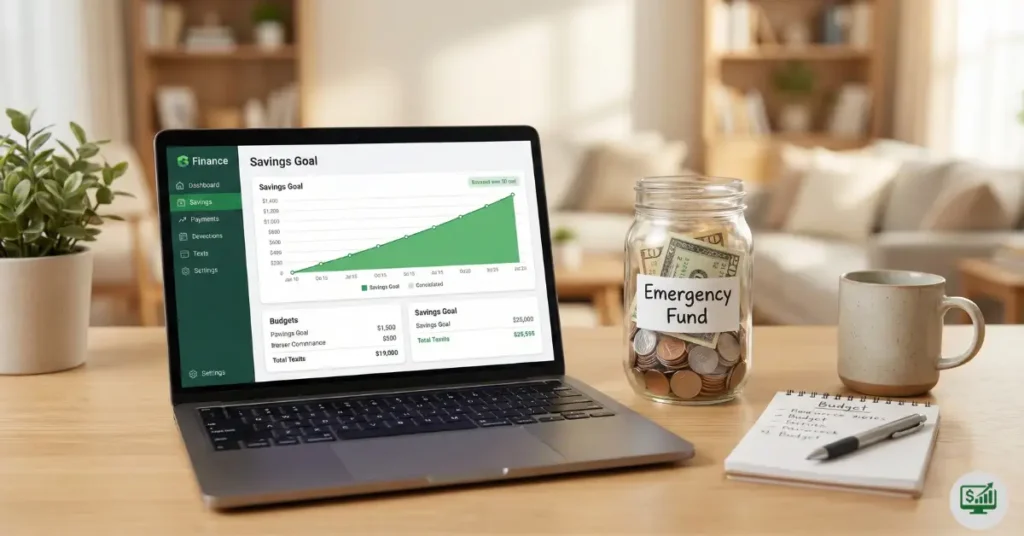
$1,000 sitting in a separate savings account.
Open:
- A high-yield savings account
- No debit card
- No instant transfers if possible
I named mine:
“Do Not Touch – Life Happens Fund”
Psychology matters.
Step 3: Find the “Invisible Money” in Your Budget
When I finally tracked my spending honestly, here’s what shocked me:
I wasn’t overspending on big things —
I was bleeding money on small habits.
Real Examples from My Own Budget
- $9 snacks at gas stations (multiple times a week)
- $14 streaming services I “barely watched”
- Amazon orders under $20 that added up to $200+
💡 Action step:
Look at your last 30 days of transactions and circle:
- Snacks
- Subscriptions
- Convenience spending
You only need to cut one or two — not everything.
Step 4: Use the “Pay Yourself First” Automation Trick
This changed everything for me.
I set up:
- Automatic transfer
- Same day my paycheck hits
- Even if it’s just $20
Why it works:
- You never “see” the money
- No willpower required
- Saving becomes boring (and boring is good)
If you wait to save “what’s left,” there will always be nothing left.
Step 5: Lower One Bill — Just One
You don’t need to renegotiate everything.
Pick one bill:
- Internet
- Phone
- Insurance
Use this exact script (yes, I’ve used it):
“Hi, I’ve been a customer for over a year.
I’m trying to lower my monthly expenses.
Are there any discounts or promotions available?”
Even $20/month saved = $240 a year toward your $1,000 goal.
Step 6: Use Cash for Problem Categories
This felt old-school, but wow — it worked.
I switched to cash envelopes for:
- Eating out
- Groceries
- Fun money
When the cash was gone, spending stopped naturally.
Cards hide pain.
Cash makes spending real.
Step 7: Don’t Touch Your Savings (Unless It’s an Emergency)
Important rule:
Emergencies ≠ wants
Emergency examples:
- Car repair
- Medical bill
- Urgent home repair
Not emergencies:
- Sale at Target
- Birthday gift panic
- “I’ll pay it back next month”
Protect that $1,000 like your peace of mind depends on it — because it does.
What Most Americans Do Wrong
Let me save you years of frustration:
Trying to save too much too fast
Waiting for a higher income
Using credit cards as emergency funds
Being ashamed of small savings
Small savings stack up — faster than you think.
A Simple $1,000 Saving Timeline (Realistic)
Here’s a real example:
- $25 per paycheck × 26 = $650
- One bill cut = $240
- One “no-spend” weekend per month = $120
➡️ Total: $1,010
No side hustle required.
No extreme frugality.
Just intentional choices.
Olivia’s Weekly Money Routine (What I Still Do)
- Friday: Check bank balance (5 minutes)
- Sunday: Plan groceries before shopping
- Paycheck day: Automatic savings transfer
- Once a month: Cancel or review one expense
That’s it. No overwhelm.
Final Encouragement (From One Real Household to Another)
If you’re living paycheck to paycheck, you’re not failing —
you’re surviving.
And saving your first $1,000 isn’t about perfection.
It’s about proving to yourself that you can.
Start small.
Stay consistent.
Protect your progress.
Small savings stack up — faster than you think.